Showing posts with label vegetable side. Show all posts

Monday, March 28, 2011

Oven-Roasted Asparagus

This is the first asparagus of the season and I just couldn't resist passing along a recipe which many of you probably already know. It is a great easy way to prepare this harbinger of spring.


1½-2 pounds asparagus, avoid pencil-thin if you can
2 tablespoons olive oil
Coarse or regular salt

1. Prepare the asparagus by snapping off the bottom of the stalks at the place where they break.
2. Preheat the oven to 475ºF.
3. Toss the asparagus with the olive oil. Spread out on a low-sided cookie sheet, lined with parchment paper or silpat.
4. Place the asparagus in the oven for 10 minutes. Shake to turn. Test for doneness. If the stalks are soft, remove from the oven. If not, return to the oven for an additional 5 minutes. If you use pencil-thin asparagus, decrease the time.
5. Remove from the oven, salt lightly, and serve.

Note: If something else is in the oven at a lower temperature, you can put the asparagus in there and watch it until it’s done. Of course, it will take a bit longer than the above times, but it’s just fine. When it’s done, remove it from the oven. You can return it briefly to reheat if you wish.

4 servings
Adapted from Crescent Dragonwagon’s Passionate Vegetarian

Broccoli with Raisins and Pine Nuts


1 bunch of broccoli, about 14 ounces
3 tablespoons olive oil
¼ cup water
¼ cup raisins or currents or more
3 tablespoons pine nuts or more
1 teaspoon salt or more to taste

1. Slice the stems of the broccoli into thin rounds. Cut the heads of the broccoli into bite-sized pieces.
2. Heat the oil in a wok or a frying pan large enough to hold the broccoli. Add 1 teaspoon salt to the oil.
3. Add the broccoli and stir to coat the broccoli with the oil.
4. Add ¼ cup water. Turn the heat down a bit and cover the pan for 3-5 minutes or until the broccoli is tender but still has a nice green color. Check to make sure the water doesn’t boil away. By the end of the cooking time, the water will be gone or almost gone.
5. Add the raisins or currents and the pine nuts and stir until they are hot and well combined with the broccoli. Taste for salt and serve.

4 servings
My own devising

Indian-Style Broccoli with Spiced Yogurt


2 large heads of broccoli, broken into florets
2 teaspoons cumin seeds
2 teaspoons fennel seeds
5 cardamom pods, seeds removed and pods discarded
¼ teaspoon sweet smoky paprika
1 cup natural plain yogurt, medium consistency (not too thick or too thin)
Zest from 1 large lemon, see photos if you need them
Juice from 1 large lemon or less if your yogurt is pretty thin
Salt and pepper to taste

1. Blanch the broccoli in boiling salted water for 4 minutes or less, until bright green.
OR
Steam the broccoli over boiling water until tender and bright green.
Drain in a colander.
2. Toast all the spices (except the paprika) in a hot pan for 2 minutes or until they become fragrant. Let them cool slightly. Grind them in a spice or converted coffee mill. Add the paprika to the mixture. Store any leftover spice mixture in a labeled jar to use the next time you make the dish.
3. Stir about half of the spices into the yogurt. Taste the result, adding more of the spice mixture to your taste, along with the lemon zest, juice, salt and pepper. Save a bit of the spice mixture for the garnish. The yogurt mixture improves if allowed to sit for an hour or more.
4. Place the broccoli in a serving bowl. Just before serving, pour out any accumulated water from the bottom of the bowl and then spoon part of the yogurt mixture over the top. Sprinkle with some of the reserved spice mix. Serve warm or at room temperature with the remaining yogurt mixture in a small bowl on the side.

4-5 servings
Adapted from Jamie Oliver’s Cook with Jamie: My Guide to Making You a Better Cook

Brussels Sprouts and Bacon


1 pound Brussels sprouts
1 tablespoon butter or bacon fat
½ cup thinly sliced bacon or pancetta
Salt and pepper to taste
3-4 tablespoons water, as needed
2 tablespoons fresh lemon or lime juice

1. Shred/slice the Brussels sprouts either by hand or with a food processor. The processor doesn’t do as nice a job as by hand, but it is so fast. See instructions for making a chiffonade if you need them.
2. Heat the butter in a large, shallow pan. When it is warm, add the sliced bacon and stir until it is soft and cooked through.
3. Add the shredded sprouts and ½ teaspoon salt and pepper. Fry until the sprouts begin to soften. Add the tablespoons of water as needed to help with the cooking and to loosen and incorporate any brown places on the bottom of the pan.
4. The sprouts are ready when they are soft and coated with the bacon juices. Most of the water will have evaporated. Adjust the seasonings. Add the lemon or lime juice just before serving.

4 servings
Adapted from Nigel Slater’s Real Fast Food

Brussels Sprout Chiffonade

Brussels sprouts have grown on me over the years. This particular recipe is just great. The slicing takes some time, so if you are doing these for a crowd, get some help. It is well worth the effort.


1 pound Brussels sprouts
4 tablespoons unsalted butter (½ stick)
½ teaspoon cumin seeds, optional
Note: If the rest of your dinner has a lot of strong flavors, you might make your sprouts without the cumin. If it is pretty bland (like roast chicken and mashed potatoes), you might increase the cumin seeds to 1 teaspoon.
½ teaspoon salt
¼ teaspoon ground black pepper
1 tablespoon fresh lime juice

1. Trim Brussels sprouts and halve lengthwise; slice crosswise into very thin slices. See instructions below.
2. Heat the butter in a large sauté pan over moderately high heat until the foam subsides. Add the sprouts, cumin seeds, salt and pepper and cook, stirring often, until the sprouts are tender, 3 to 5 minutes. You may want to add 1-2 tablespoons of water to hasten the cooking. The water will disappear and the sprouts will be done.
3. Transfer to a serving bowl. Stir in the lime juice and taste for seasonings, adding more salt and pepper if necessary.

4-6 servings
Adapted from Ruth Reichl’s The Gourmet Cookbook

How to chiffonade Brussels sprouts

1. Trim the Brussels sprouts and halve lengthwise.
 2. Cut crosswise into very thin slices.
3. As you finish cutting, place the slices in a bowl and pull them apart into shreds (or chiffonade).

Braised Carrots


2 tablespoons olive oil
1 pound carrots, peeled and cut into 3½ x ½ x ½-inch sticks
6 cloves garlic, peeled and sliced
2 medium tomatoes, seeded and chopped
¼ cup chopped fresh mint
3 slices lemon, seeds removed, plus juice from the rest of the lemon
1 tablespoon sugar
1 teaspoon salt
½ teaspoon anise seeds
½ teaspoon ground cumin
Pepper
2 tablespoons chopped fresh parsley

1. Put the oil and the carrots into a heavy 10-inch skillet. Cook on high heat, stirring and shaking the pan often and scraping the browned bits occasionally with a wooden spoon, until the carrots have lightly browned, about 10 minutes.
2. Add the garlic, tomatoes, mint, lemon slices, sugar, salt, anise and cumin; mix well.
3. Cook until bubbling vigorously; reduce heat to low. Cover and cook for 10 minutes. Stir, turning the carrots. Cover and cook until the carrots are very soft, 10 minutes or so more. Add lemon juice and season with pepper. Remove the lemon slices.
4. Before serving, sprinkle with parsley. Serve hot or at room temperature.

If you make this ahead, you can reheat for 1-2 minutes in the microwave.

4 servings
Adapted from Eating Well, February/March 2006

Cauliflower with Garlic and Pepper


2 tablespoons vegetable oil
1 tablespoon chopped garlic
1 head of cauliflower, broken into small florets
2 tablespoons fish sauce
6-8 tablespoons water
1 teaspoon sugar
½ teaspoon black pepper
2 green onions, trimmed and cut into 1-inch lengths or 2 tablespoons chopped shallots
2 tablespoons coarsely shopped fresh cilantro, dill or mint

1. Heat the oil in a large skillet over medium-high heat. Add the cauliflower to the pan and cook for 1 minute, toss well, exposing all sides to the hot pan. Once the cauliflower is nicely browned, add the garlic and stir well to combine.
2. Add the fish sauce, water, sugar, pepper, and green onions to the pan. Cook, tossing often until the cauliflower is tender, but not mushy, about 5 or more minutes.
3. Just before serving, reheat in the microwave as needed. Then stir in the fresh herbs, transfer to a shallow serving bowl and serve hot or warm.

4 servings
Adapted from Nancie McDermott’s Quick and Easy Vietnamese

Eggplant Slices with Pomegranate, Yogurt and Tahini

This is superb. I've served this for Thanksgiving, believe it or not, along with everything else. I consider this a vegetable side dish but you might think of it as a salad. It doesn't matter. Just enjoy.


2 globe eggplants, or as many eggplants as it takes to make about 2½ pounds
Olive oil
Salt
1½ tablespoon pomegranate molasses
1½ tablespoon red or white wine vinegar
2 cups plain whole-milk yogurt, drained if it is very soupy, see instructions
1 garlic clove, crushed
2 tablespoons tahini
¼ cup pine nuts
¼ cup pomegranate seeds

1. Cut the eggplant in half lengthwise and then crosswise into 5/8-inch slices. Place them on an oiled sheet of foil on a rimmed baking sheet. Brush both sides of the eggplant with oil and sprinkle lightly with salt.
2. Place in a very hot 475ºF oven for about 30-40 minutes, until they are soft and browned, turning the slices once mid-way through cooking.
3. Mix together the pomegranate molasses, vinegar, and 2 tablespoon olive oil. Brush the eggplant slices with the dressing and arrange them on a large platter. You may have some dressing left over; use your discretion as to the amount the eggplant can absorb.
4. Whisk the yogurt with the garlic and tahini and pour over the slices. Fry the pine nuts very briefly in ½ tablespoon of olive oil or toast them in your toaster oven, watching them carefully, until they are light brown. Sprinkle the pine nuts and the pomegranate seeds over the yogurt. Serve at room temperature.

4 servings as a side dish
Adapted from Claudia Roden’s Arabesque: A Taste of Morocco, Turkey and Lebanon

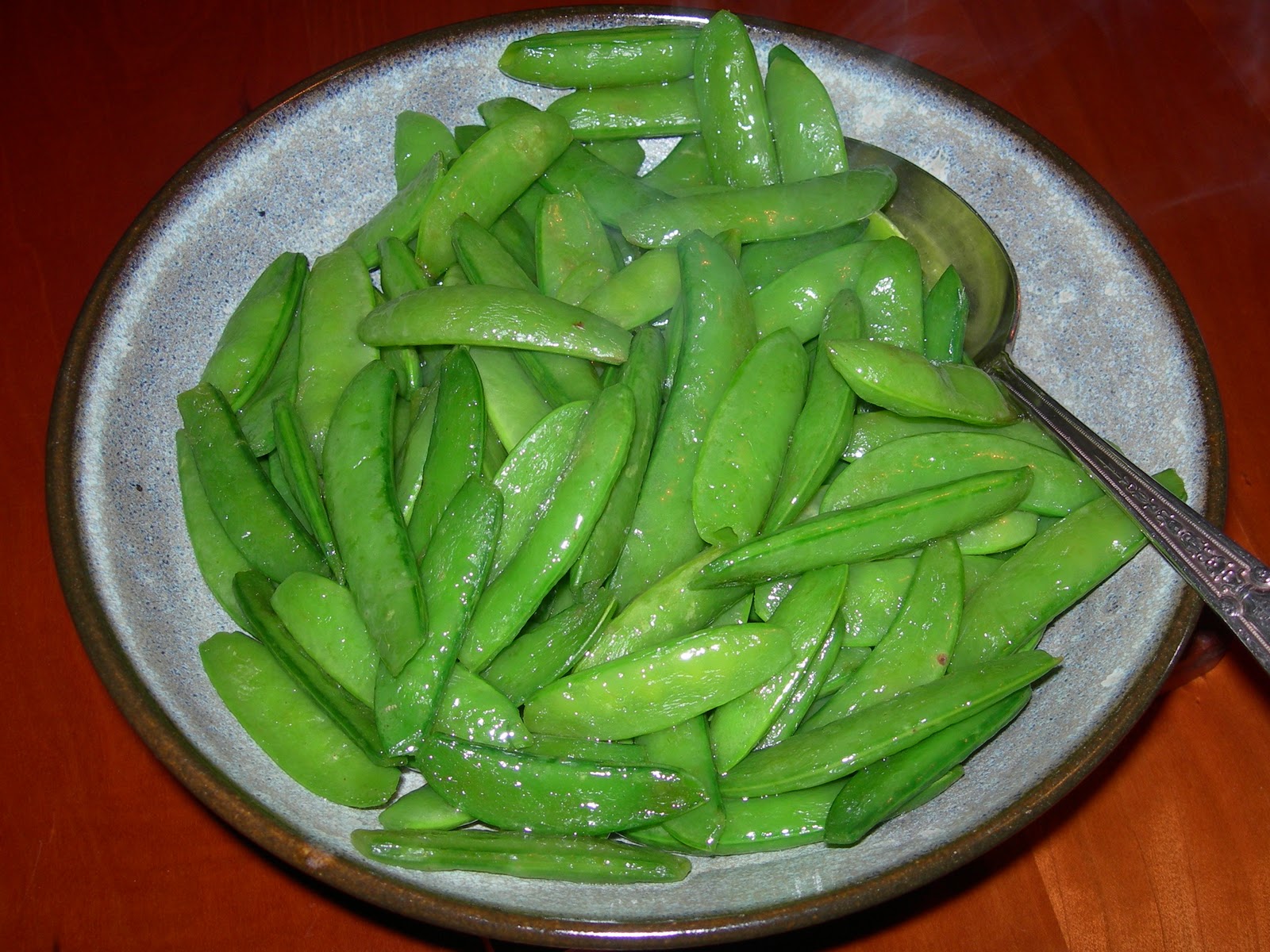
Stir-Fried Sugar Snap or Snow Peas

The peas are a great color and have a delightful crunch in your mouth. They can be de-strung ahead of time but need to be fried at the last moment.


1 pound fresh sugar snap or snow peas
2 tablespoons olive oil
1 teaspoon salt

1. Pull the strings, if any, from the peas, snapping off the top stems and bottom flags if necessary.
2. Heat a frying pan or wok. Add the oil and the salt.
3. Toss in the peas and stir fry until the peas are tender, but still bright green and a little crunchy. You might add a tablespoon or two of water to speed along the cooking. Stir until the water disappears.

4 servings
My own devising

Silky Sautéed Red Peppers


3 red bell peppers
1/3 cup plus 2 tablespoons red wine vinegar or balsamic vinegar
½ teaspoon sugar
1 teaspoon salt
2 tablespoons extra virgin olive oil

1. Wash the peppers, halve them lengthwise, and remove and discard the seeds and membranes. Cut each pepper half in half, cross-wise. Cut into ½-inch wide strips.
2. Place in a very large skillet and toss with the 1/3 cup vinegar, sugar and salt. Cover and cook over low heat until soft and tender, about 25 minutes. Toss occasionally, adjusting the heat so the peppers cook slowly. The liquid will have nearly evaporated by the end of the cooking. Watch that the peppers don’t scorch.
3. When done, transfer them to a platter. Return the skillet to the heat, and deglaze with the final 2 tablespoons of vinegar, scraping up any of the flavorful bits that may have remained in the pan. Add the oil, and heat until just warmed through.
4. Pour the liquid over the peppers, toss, and taste for seasoning. Serve right away or cool for at least 30 minutes before serving at room temperature.

4-6 servings as a side dish
Adapted from Patricia Wells’ Trattoria

Simple Sautéed Fresh Spinach or Swiss Chard


Spinach for as many as you are serving, about ¼ pound per person, depending on the serving size
OR
Swiss chard, about 1 bunch for 2 servings, stems removed, washed well, cut into ½-inch strips
Olive oil, about 1 tablespoon per serving

1. Place your spinach or chard in a non-aluminum pot big enough to hold your quantity of greens. Add 2 tablespoons of water and up to 3 tablespoons of olive oil.
2. Cover the pan and cook on low heat. The spinach will begin to wilt and give up its water. The chard will have the washing water still clinging to it; it will also begin to wilt but more slowly than the spinach. Stir to turn the uncooked spinach or chard toward the bottom surface of the pan. Keep stirring and cooking until all the spinach is cooked. With the chard, turn the heat to low, cover the pan and simmer for about 10 minutes until tender.
3. Serve immediately. You can also hold it for a short while after cooking. Rewarm gently before serving.

I never find it necessary to add salt because of the high oxalic acid in the spinach.
To add garlic, mince or press several garlic cloves into the spinach or chard at the same time as you add the water and oil.

Makes as much as you desire or your pot will hold
My own devising

Summer Squash Gratin

You can serve this as a side dish. With the addition of some salami or bacon, you could also serve it as a main dish with a nice green salad.


1¼ pounds yellow squash or zucchini, cut into ½-inch squares
1 tablespoon butter or olive oil
1 small onion, finely diced
½ cup salami, prosciutto, bacon, or pancetta, coarsely chopped, optional
1 cup diced Monterey Jack or Swiss cheese (actually any melting cheese would work)
2 tablespoons grated Parmesan cheese
1/3 cup crème fraiche or sour cream
1 tablespoon white vermouth or dry white wine
1 teaspoon ground coriander
Generous pinch of ground nutmeg
Generous pinch of cayenne or Aleppo pepper
2-3 tablespoons fresh dill, chopped
Salt and ground pepper to taste
1½ cups fresh breadcrumbs
2 tablespoons melted butter

1. Lightly butter a 10-inch gratin dish or casserole.
2. Steam the squash until tender, about 6-8 minutes. Remove to a medium bowl.
3. Heat the butter or oil in a small skillet and add the onion and the optional meat. Cook until soft but not browned. Add to the squash along with the cheeses, the crème fraiche or sour cream, the wine, coriander, nutmeg, cayenne, dill, salt and pepper.
4. Pour into the prepared dish. Combine the breadcrumbs and melted butter; sprinkle over the top of the squash. You can also cook the breadcrumbs in a frying pan with the butter until they are toasted and crisp.
5. Bake at 350ºF until bubbling and nicely browned, about 35 minutes.

4-5 servings
Adapted from Irma S. Rombauer, Marion Rombauer Becker and Ethan Becker’s The All New All Purpose Joy of Cooking (from 1997). Earlier versions of this cookbook called this recipe Summer Squash Casserole.

Six-Spice Winter Squash Purée

This is just incredibly good when the squashes are tender, flavorful, and moist.


1 large (or 2 small to medium) butternut squash, about 2 pounds
Note: The most recent time I used a mix of delicata, butternut, and kabocha.
2 tablespoons butter
2 tablespoons maple syrup
2 teaspoons salt or more to taste
1½ teaspoons Spice Mixture, see recipe below

1. Preheat the oven to 325ºF. Lightly oil a baking sheet with olive oil or line with parchment paper.
2. Halve the squash lengthwise and remove and discard the seeds. Place the squash cut-side down on the baking sheet and roast until it is soft and easily pierced with a knife, 40-50 minutes. While it is roasting, make the Spice Mixture.

3. Cool the squash for 15 minutes. If the squash looks watery after roasting, squeeze as much of the juice out of it as you can. If it is very dry, be prepared to add a lot more liquid to the mixture (orange or apple juice, stock, even water).


4. Using a large spoon, scoop out the flesh and transfer to a food processor. While the squash is still warm, add the butter, maple syrup, and salt and process until smooth. Add the Spice Mixture and blend. Add additional salt or Spice Mixture to taste. Spoon into a serving bowl and bring to the table at once.
5.  If you want to make the dish ahead, spoon it into an oven-proof casserole and reheat it at 300ºF for about 30 minutes.

6 servings
Adapted from Matthew Kenney’s Big City Cooking

Spice Mixture

1 tablespoon fennel seed
5 or 6 whole star anise
1 tablespoon aniseed
1 tablespoon ground cinnamon
1 tablespoon ground black pepper
1 tablespoon ground cloves

1. Grind the fennel seed, star anise and aniseed in a coffee or spice grinder.
2. Combine with the cinnamon, pepper, and cloves and set aside. You will have about 1/3 cup.
3. Store the leftovers in a spice jar; label the jar so you don’t forget the contents.

Makes about 1/3 cup
Adapted from Matthew Kenney’s Big City Cooking

Saturday, March 26, 2011

Oven-Roasted Tomatoes

I am crazy about roasted tomatoes. I love the way the roasting concentrates the flavor and gives your mouth a quintessential tomato hit. And they always add a nice color to the table and your plate.


3 pounds small to medium tomatoes of any kind or color
OR
2-3 boxes of cherry tomatoes
2 tablespoons olive oil
1 teaspoon kosher salt

1. Cut the regular tomatoes in half crosswise and remove the seeds.
OR
Poke a hole in each of the cherry tomatoes.
2. Place in a bowl. Drizzle with olive oil and salt. Mix together.
3. Place the cherry tomatoes or the regular tomatoes with their cut side up in a single layer on low-sided pans lined with parchment paper or silpat. Roast in a 350ºF oven. No need to preheat. You can use convection mode on either roast or bake if your oven has that feature.
4. Bake in the oven until the skins are wrinkled and juices evaporated somewhat. The flesh should still be moist and soft to the touch. For regular tomatoes, count on 1-2 hours; for cherry tomatoes, one hour should be sufficient. If you are using convection, the times will be shorter. You can remove the tomatoes that are starting to caramelize (and potentially burn) if you desire.
6. Remove from the oven and cool.

4 servings
Adapted from a Ramekin’s cooking class taught by Mary Karlin, August 2004.

Oven-Roasted Tomato Variation


I tried something slightly different with a batch of tomatoes I purchased from The Patch last summer.
I did the usual washing, cutting in half around the equator, taking out as many of the seeds as I can with my finger, placing them close together in a glass dish and seasoning with salt and pepper. You can also use a rimmed baking sheet. I didn’t sprinkle any olive oil over them.

I roasted at 400ºF for about 15 minutes and then lowered the temp to 300ºF until they were much reduced in volume but still nice and squishy, about 2 or 2½ hours. Maybe more. (If you need to roast some beets--or anything else for that matter, you can do them at the same time. They’ll just take longer than at their usual temperature.)

I let them cool, placed them on a serving plate and drizzled them with Maple Smoked Olive Oil and then placed a small mound of Délice de la Vallée, a combination of cows’ milk and cream and goats’ milk on top. Both products are made in Sonoma County. You can substitute any good olive oil or soft cheese.

Oven-Roasted Zucchini


8 medium zucchini, thickly sliced (½ inch) on the bias
2 tablespoons olive oil
2 garlic cloves, pressed
OR
2 roasted garlic cloves, chopped, and 1 fresh garlic clove, pressed
2 tablespoons chopped fresh flat-leaf parsley
6 fresh basil leaves, chopped or ¼ cup chopped herbs of your choice
Note: Tarragon and chervil or tarragon and thyme or oregano and thyme or dill are all good.
Zest of 1 lemon, see photos if you need them
Juice of ½ lemon
Salt and pepper

1. Place the zucchini in a roasting pan(s). Add the olive oil, toss to coat, and arrange in a single layer. Sprinkle lightly with salt. Put the pan(s) in the oven and turn the temperature to 425ºF. Roast for 30-40 minutes, turning once mid-way. The zucchini should be nice and brown on both sides.
2. Mix together the garlic, parsley, lemon zest, and herbs.
3. Make a layer of some of the zucchini slices on a serving dish. Sprinkle with some of the herb mixture, season with salt and pepper and drizzle with the lemon juice. Continue making layers until all the ingredients are used, ending with some herbs on top.
4. Set aside in a cool place for about an hour for the flavors to mingle before serving. Can serve warm or at room temperature. To warm slightly, put the dish in a microwave and heat for 1-2 minutes.

Note: I have made just steps 1 and 2 of this recipe with salt added along with the olive oil. Even at its most simple, it is a delicious dish.

4-5 servings
Adapted from The Silver Spoon, a comprehensive cookbook of Italian food